

Where Tourism Learns to Hold Its Breath
There are places in South Africa where tourism behaves politely. Cameras click, brochures get fulfilled, memories are packaged and carried home like seashells.
Then there are places like Bloukrans, where tourism stops being polite and becomes bodily. Immediate. Unignorable.
On the edge of the Tsitsikamma region in the Western Cape, Bloukrans Bridge spans a gorge so deep it seems to subtract certainty from the air itself. It is a civil engineering structure that doubles as a psychological instrument. People arrive expecting a thrill. What they encounter is a carefully constructed encounter with controlled fear.
Bungee jumping here is not an isolated attraction. It is a system. A choreography of engineering, operator discipline, environmental framing, and human psychology all meeting at a single moment of voluntary freefall.
Adventure tourism often gets reduced to adrenaline. At Bloukrans, it is more accurate to describe it as risk made legible.
Risk Is Not Removed, It Is Structured
Adventure tourism does not function by eliminating danger. It functions by converting uncontrolled danger into controlled conditions that behave predictably.
At Bloukrans Bridge, this conversion is not symbolic. It is physical and procedural. Every component of the jump exists within a layered safety architecture designed to reduce uncertainty at multiple points before anything reaches the participant.
The cables are engineered with load tolerances that far exceed the forces generated by a jump. Harness systems distribute stress across multiple contact zones rather than a single point. Connection systems are designed with redundancy, meaning that no single component is solely responsible for holding a participant.
Inspection routines are repeated and cross-verified. Equipment is not assumed to be safe because it worked previously. It is treated as needing continuous confirmation.
The result is a structure where risk is not removed, but contained within predictable parameters.
This distinction matters. The experience feels like stepping into unpredictability. The system behind it is built on the opposite principle: eliminating unpredictability wherever engineering allows.
What remains is perception.
The Operator as a Safety Interface
In extreme tourism environments, operators are not background staff. They are the living interface between system safety and human perception.
At Bloukrans, operators carry a dual responsibility. They manage equipment procedures with technical precision while also managing human emotional states in real time.
A jumper arriving at the platform is not just a participant. They are a nervous system under load. The operator’s role is to ensure that this nervous system remains functional enough to follow instructions safely.
This requires more than procedural knowledge. It requires behavioural reading.
Operators are trained to identify hesitation patterns that might indicate cognitive overload. These can include sudden silence, excessive talking, repeated questioning, or abrupt emotional shifts. None of these behaviours are inherently dangerous on their own, but they can signal that a person is moving beyond their optimal decision-making threshold.
Communication becomes a tool of regulation. Instructions are delivered with consistency and calm authority. Not theatrical reassurance, but structured clarity.
Even the rhythm of speech matters. Too fast and it increases panic. Too slow and it creates doubt loops.
Safety here is not just mechanical. It is conversational.
The Edge Effect: What Happens Before the Jump
Standing on a bungee platform produces a predictable psychological response pattern, regardless of personality type or prior intention.
The brain begins to reorganise sensory priorities. Depth perception becomes exaggerated. Sound feels closer. Time feels less linear. The body begins to over-monitor balance even though balance is no longer relevant.
This is sometimes referred to in behavioural psychology as an edge effect, where proximity to a perceived drop triggers heightened threat processing.
At Bloukrans, this effect is intensified by environmental scale. The gorge below removes visual grounding points. There is no easy reference frame to reassure the nervous system.
People often interpret this moment as fear arriving suddenly. In reality, fear is already present. It simply becomes louder than other cognitive processes.
Operators are trained to recognise this stage. It is where instruction becomes most important. Clear sequencing replaces internal dialogue. Step-by-step guidance prevents cognitive spirals that can lead to hesitation overload.
Importantly, hesitation is not treated as failure. It is treated as data. Participants are never forced beyond their readiness threshold. The system is designed with exit points before commitment.
Why Fear Feels Larger Than Physics
One of the central paradoxes in adventure tourism is the difference between actual risk and perceived risk.
From a technical standpoint, bungee jumping is a highly controlled activity with multiple redundant safety systems. From a psychological standpoint, it can feel indistinguishable from uncontrolled falling.
The human brain does not naturally calculate statistical safety in real time. It responds to visual cues, height perception, and instinctive threat modelling that evolved for natural environments rather than engineered systems.
A 216-metre drop does not register as a managed experience. It registers as exposure.
This mismatch between perception and reality is not a flaw in the system. It is the system’s defining feature.
Adventure tourism exists precisely because it allows people to inhabit this gap safely. The body experiences fear signals while the structure ensures those signals do not correspond to uncontrolled danger.
Operators do not attempt to remove fear. They work within it. Their task is to ensure that fear does not override compliance.
Safety, in this context, is not emotional comfort. It is behavioural stability under pressure.
The Jump Sequence as Engineered Ritual
Every jump at Bloukrans follows a structured operational sequence that prioritises repetition and predictability.
Harness fitting is performed with deliberate thoroughness. Multiple checks are conducted by different staff members to ensure consistency. This redundancy reduces the likelihood of human error and reinforces participant confidence through observable process.
Before the jump, participants receive posture instruction. This is not symbolic. Body alignment affects force distribution during the initial acceleration phase. Small adjustments in stance can influence how the body transitions from stillness to motion.
The countdown is not theatrical. It functions as a cognitive anchor. It provides temporal structure to a moment that otherwise feels directionless.
Then comes the release.
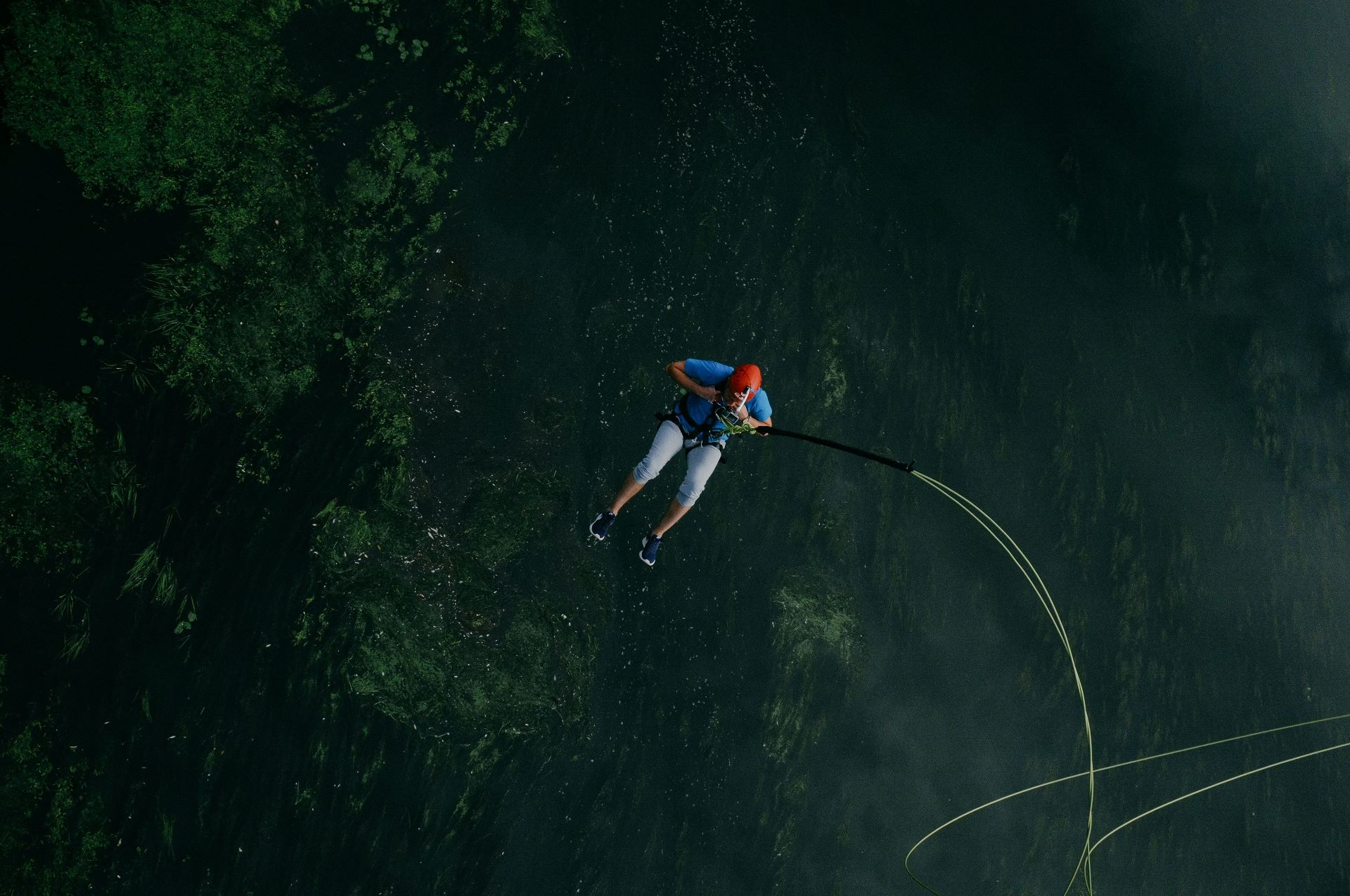
The transition from stillness to freefall is abrupt. The body loses reference points almost immediately. Gravity becomes the dominant sensory input. Orientation is replaced by motion awareness.
The experience is often described as overwhelming, but it is more accurate to describe it as unstructured input. The brain receives more sensory information than it can categorise in real time.
The cord then begins its elastic response phase, converting downward momentum into upward motion. This creates oscillation cycles governed by material properties rather than human perception.
What feels chaotic is mechanically predictable.
The Aftershock Phase: When the Body Relearns Stillness
What happens after the jump is often overlooked in discussions about adventure tourism, yet it is one of the most psychologically significant parts of the experience.
Once the jump concludes, the nervous system does not immediately return to baseline. It remains in a heightened state of activation for a short period. Heart rate, breathing patterns, and cognitive alertness gradually recalibrate.
This creates a transitional phase where emotional responses can surface unexpectedly. Laughter is common. Silence is equally common. Some participants become highly talkative, while others become introspective.
This variability is not random. It reflects how different nervous systems process intense stimulus resolution.
At Bloukrans, staff are accustomed to this phase. It is integrated into the operational experience even if it is not formally presented as part of the attraction.
Psychologically, this is where meaning formation begins. The brain attempts to interpret what just happened and integrate it into personal narrative structure.
The phrase “I did it” carries disproportionate weight because it represents successful navigation of an internal prediction system that expected avoidance rather than completion.
Environment as Psychological Amplifier
The physical environment surrounding Bloukrans Bridge plays a significant role in shaping the psychological experience of the jump.
The gorge creates extreme vertical separation, which intensifies depth perception. The absence of nearby reference structures reduces visual grounding. The result is a heightened sense of scale that the brain interprets as increased exposure.
Wind patterns contribute subtle variability to sensory input, reinforcing the perception of instability even when structural conditions remain constant.
Yet the environment is not purely amplifying. It also provides contrast. The surrounding Tsitsikamma landscape introduces natural beauty that prevents the experience from becoming purely mechanical or clinical.
This balance between aesthetic calm and structural intensity is part of what defines the site.
Adventure tourism relies heavily on this environmental duality. The setting is not just background. It is part of the psychological system.
Professional Identity in High-Risk Tourism
Working in an environment like Bloukrans requires a specific professional mindset that differs significantly from conventional tourism roles.
Operators are not engaged in thrill-seeking behaviour. Their relationship with risk is procedural rather than emotional. Familiarity with high-intensity environments is developed through repetition and training rather than personal appetite for adrenaline.
Training emphasises consistency, attention to detail, and emotional regulation. Procedures must be executed identically regardless of external conditions such as weather changes or crowd volume.
This consistency is essential because it ensures that the participant experience is not dependent on operator mood or variability.
There is also a strong culture of accountability. In environments where physical outcomes are immediate and irreversible, precision is not optional. It is structural.
Operators often describe their role as enabling transformation rather than delivering excitement. The distinction is subtle but important. The goal is not to create danger. It is to manage perception of danger within safe boundaries.
Safety Systems as Hidden Infrastructure
Much of what makes Bloukrans operationally safe is never visible to participants.
Behind the experience lies a network of maintenance schedules, inspection protocols, equipment lifecycle tracking, staff training systems, and emergency preparedness planning.
Each jump is part of a larger system that ensures repeatability. The goal is not to create one successful jump. The goal is to ensure that every jump meets the same safety threshold regardless of conditions.
This requires discipline across time rather than improvisation in the moment.
Safety systems in this context function like invisible infrastructure. They are not experienced directly, but they shape every aspect of what is experienced.
The reliability of the system is what allows psychological intensity to exist without physical unpredictability.
The Ethics of Designed Fear
Adventure tourism raises an interesting ethical question. If fear is intentionally generated for recreational purposes, where does responsibility lie?
At Bloukrans, the ethical framework is built around consent and control.
Participation is voluntary at every stage. Opt-out points exist before final commitment. Instructions are designed to support informed decision-making rather than pressure.
The fear experienced is real, but it is contextualised within a controlled environment where physical risk is managed through engineering and procedure.
Operators are trained to respect hesitation rather than override it. Coercion has no place in this environment because trust is the foundation of operational safety.
This ethical structure is what separates adventure tourism from recklessness. The goal is not to push individuals into danger. It is to allow them to engage with fear safely and temporarily.
Why Bloukrans Has Become a Reference Point
Bloukrans Bridge has developed a global reputation not because it is simply high, but because it represents a mature integration of safety systems, operator discipline, and environmental design.
It functions as a reference point for how extreme tourism can be structured without compromising operational integrity.
Visitors are not only drawn by the physical drop. They are drawn by the assurance that the system surrounding the drop is consistent and reliable.
In this sense, the attraction is not the fall itself. It is the certainty that makes the fall possible.
Adventure tourism at this level is not about chaos. It is about controlled exposure to uncertainty within engineered limits.
The Space Between Decision and Drop
At Bloukrans Bridge, tourism becomes something more precise than entertainment. It becomes a structured encounter with perception itself.
The jump is not an escape from fear. It is an arrangement where fear can be observed, experienced, and contained without consequence.
Every system involved, from engineering to operator behaviour, is designed to maintain that boundary between perception and reality.
What remains for the participant is a brief moment where instinct and instruction coexist, where the body prepares for something the structure has already accounted for, and where uncertainty is present but managed.
In that moment, the experience is not simply about falling.
It is about discovering how tightly fear and control can exist in the same space without collapsing into each other.
Ronel Ferreira
Reporting from the frontlines of the South African tourism renaissance. Bridging the gap between regional stories and global audiences through elite narrative strategy.