

The Karoo is a place that defies comparison. Stretching over 400,000 square kilometres of ancient semi-arid landscape, this sprawling interior plateau is often dubbed South Africa’s soul — a place where the silence hums, where the earth tells stories older than memory, and where the stars fall so close you feel you could reach out and touch them. It is here, beneath the endless dome of the Southern Hemisphere’s clearest night skies, that some of South Africa’s most awe-inspiring self-guided hiking trails await those brave enough — or wise enough — to wander into the wilderness.
In the Karoo, hiking isn’t just about the terrain, although that alone is compelling: fossil-rich shale beds, rust-coloured koppies, flat-topped mesas, saltpans, and gorges carved over millennia. It’s about the sense of timelessness, the unmediated connection to something larger than the self, and the quiet pride in finding your way with a map, a water bottle, and your own two feet. These are hikes that demand presence. They require preparation, yes, but above all, they invite immersion.
What makes self-guided hikes in the Karoo so distinctive is the solitude. This is not a region of crowds or curated viewpoints. Here, the view is everything — and nothing is manufactured. Trails are often unmarked, paths are beaten not by boots but by animals, and the sense of discovery is real. This is not wilderness tamed; it is wilderness shared. It is vastness experienced not through signboards and tour guides, but through wind, silence, and the crunch of gravel beneath your soles.
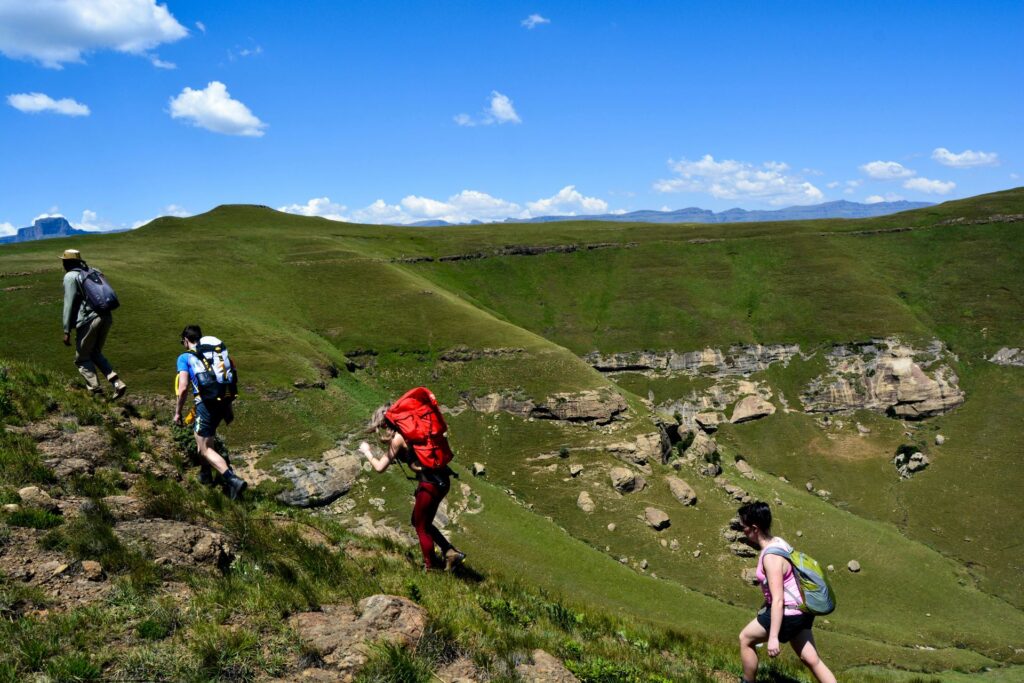
The Magic of Midnight Mountains and Milky Way Walks
To understand the full magic of hiking in the Karoo, one needs to understand the sky. This is, after all, one of the world’s premier stargazing destinations. When the sun dips behind the koppies, an entirely different kind of trail reveals itself — one stitched not across the landscape, but across the heavens. The Karoo’s minimal light pollution means that night hikes, or hikes that end with twilight bivouacs, become celestial performances. The Milky Way is not a faint suggestion here. It’s a river of stars so bright and full that even seasoned stargazers find themselves gasping aloud. Shooting stars become companions, and constellations feel like ancient maps drawn just for you.
This extraordinary nightscape adds a profound layer to daytime treks. Trails that climb above the plains — such as those weaving through the Compassberg near Nieu-Bethesda, or winding up the Groot Swartberg range above Prince Albert — allow hikers to bed down in rustic campsites or stone shelters where darkness becomes a gift. With no electricity and minimal human infrastructure, evenings are about firelight, stories, and staring up into an infinite cosmos.
Walkable Wilderness and Where to Wander
The Karoo, despite its remoteness, offers a surprisingly wide range of self-guided hiking experiences. From well-marked trails on private reserves to completely untamed multi-day treks that require route-finding skill and logistical foresight, there’s a walk for almost every level of experience — as long as hikers come prepared for isolation, fluctuating temperatures, and no cellular signal.
The Tankwa Karoo, for example, is a study in stark beauty. Its flat expanse and distant ridgelines may seem inhospitable, but hidden among the gravel plains are remarkable trails along dry riverbeds and fossil banks, where ancient marine creatures lie fossilised in the stone. Hikes in this region are more contemplative than physically demanding — distances stretch long, but elevation gain is minimal. The reward, beyond the mind-bending sunsets and Martian terrain, is the rare privilege of walking in utter solitude.
Further south, near the Karoo National Park outside Beaufort West, hikers can follow the Pointer Trail or Klipspringer Trail — both self-guided loops that explore the ridges and valleys of the Nuweveld Mountains. Here, steep climbs and switchbacks are balanced by panoramic views and sightings of black eagle, kudu, and even the elusive mountain zebra. Overnight shelters dot the longer routes, allowing hikers to break their journey and sleep out under a sky still unspoiled by artificial light.
The Camdeboo region, encompassing the plains and peaks around Graaff-Reinet, is another hiker’s paradise. The Valley of Desolation — a cathedral of dolerite columns — is as visually spectacular as any national monument, but far fewer travellers know that from its edges stretch a network of self-guided trails, including the Eerstefontein Trail and the Agave Trail. These paths traverse transitional zones where Karoo scrub meets mountain fynbos, making for fascinating botanical juxtapositions.
Then there is the less-frequented Upper Karoo, towards Calvinia and Williston, where ancient rock engravings from the /Xam San people whisper of lost languages and long walks. Here, hiking is both physical and archaeological — a literal journey across time. Trails are often unmarked, with directions given by local farmers and maps drawn by hand. Yet the reward is unmatched: access to an ancient, sacred landscape untouched by mass tourism and wrapped in a kind of reverence.
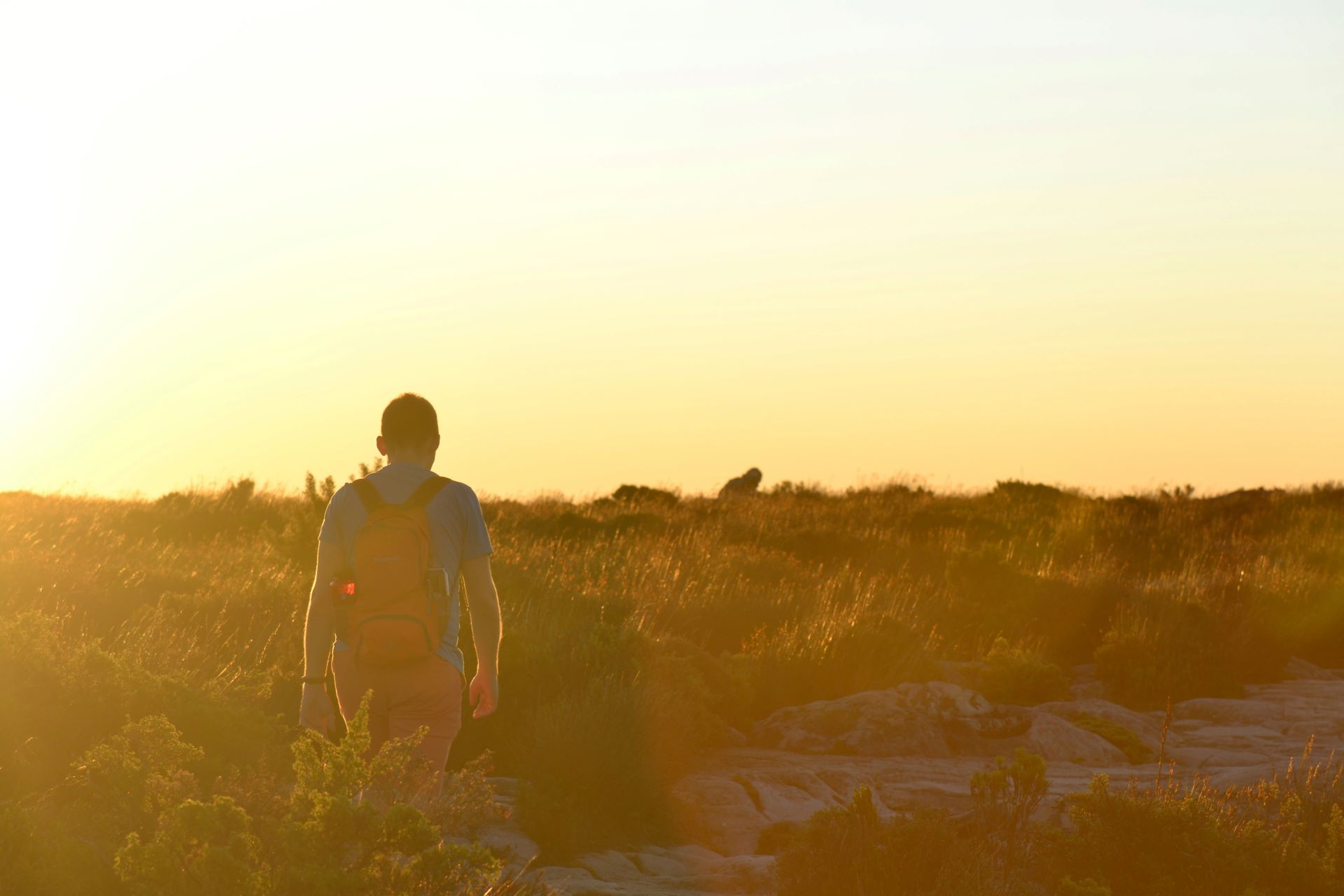
Hiking Alone, Together
One of the most rewarding — and challenging — aspects of self-guided hiking in the Karoo is the necessity of self-reliance. While many trails are maintained by private landowners, nature conservancies or SANParks, they are rarely crowded and often unsigned. That means route planning, map reading, and carrying sufficient supplies are essential. Cell signal is unreliable at best and non-existent at worst, so hikers are urged to leave detailed itineraries with friends or lodge hosts, and ideally carry satellite messengers or beacons.
But self-reliance doesn’t mean isolation. On the contrary, hiking in the Karoo often introduces travellers to a kind of community that feels both generous and grounded. Farmsteads double as trailheads, and many locals — particularly in towns like Sutherland, Matjiesfontein, and Prince Albert — are passionate about their terrain and eager to share advice. Trail markers may be absent, but hospitality is not. Whether it’s a cup of moer coffee offered at dawn or a hand-drawn map copied from a kitchen table, hikers quickly learn that the Karoo’s heart beats strongest in its people.
Moreover, hiking in the Karoo doesn’t always mean sleeping in tents. An increasing number of self-catering cottages and off-grid eco-lodges now cater specifically to the independent traveller. Trails often begin and end at these accommodations, offering the comfort of a bed, a hot shower and a starlit veranda without losing the sense of wildness that defines the region.
A Slow Pilgrimage
If there's one thing that hiking in the Karoo teaches, it’s the art of slowing down. This is not terrain to be rushed. Distances between towns are vast, and the trails themselves are generous with time — inviting long pauses, mid-day rests in rock shadows, and late starts that follow sunrise coffee and campfire bread.
Self-guided hiking here becomes a kind of pilgrimage, not in the religious sense, but in the sense of intentional movement. Every day on the trail feels like an act of reconnection — with the land, with history, and with self. It is hard to describe the transformation that happens when you go several days without hearing an engine or seeing a powerline. The silence stops being empty and starts being eloquent.
For many, the highlight of these hikes isn’t a summit or a view. It’s the quiet joy of the journey itself — the rhythm of walking, the slow curve of sunlight on stone, the whisper of wind over dry grass, the sound of your own breathing becoming steady and sure. And at night, it is the ritual of looking up and recognising the Southern Cross, Orion, or Scorpius — ancient sky-beasts that have watched over these plains for thousands of years.
Conservation on Foot
An important dimension of Karoo hiking is its contribution to conservation. Much of the region’s land remains in private hands, and the shift towards eco-tourism — particularly low-impact activities like hiking — offers both economic and ecological benefits. Several community conservancies and family-run farms have embraced hiking as a way to rewild marginal land, restore indigenous vegetation, and provide alternative income streams that keep families on the land without resorting to extractive practices.
Walking here, then, is more than recreation. It becomes a quiet act of stewardship — a way of affirming the value of untouched spaces and the importance of preserving ancient ecologies. Hikers are often encouraged to report wildlife sightings, identify rare plant species, and respect sensitive areas like fossil beds and rock art sites. In return, they gain access to one of the most unfiltered, unmediated wilderness experiences available in Southern Africa.
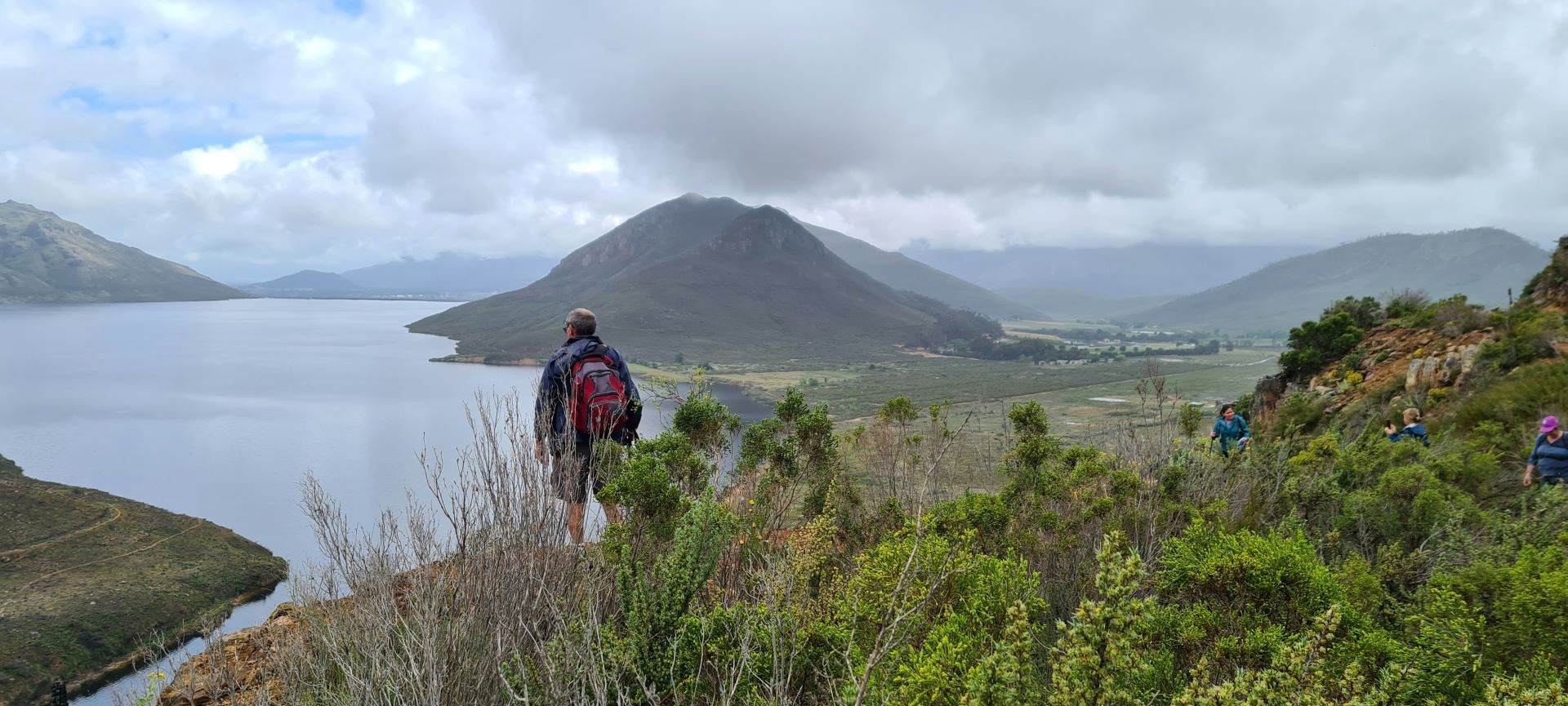
A Place to Return To
The Karoo is not the kind of place you visit once. Like the best trails, it calls you back — again and again — each time showing you something different. The landscape changes with the seasons, with the rains, with the shifting light. So too do its trails, which reveal new stories with every step. A koppie climbed in April may feel different in October. A path walked at dawn will look entirely changed in the gold of late afternoon. And no two night skies are ever the same.
To walk in the Karoo is to make a kind of pact — a personal covenant with silence, space, and stars. It is a promise to honour slowness, to embrace solitude, and to remember that even in an age of digital maps and constant connection, the best journeys are still those you walk yourself.
So pack your boots, fill your water bottles, and head for the wide horizons. There are trails waiting. And above them, stars watching.
Elisha Roodt
Reporting from the frontlines of the South African tourism renaissance. Bridging the gap between regional stories and global audiences through elite narrative strategy.